
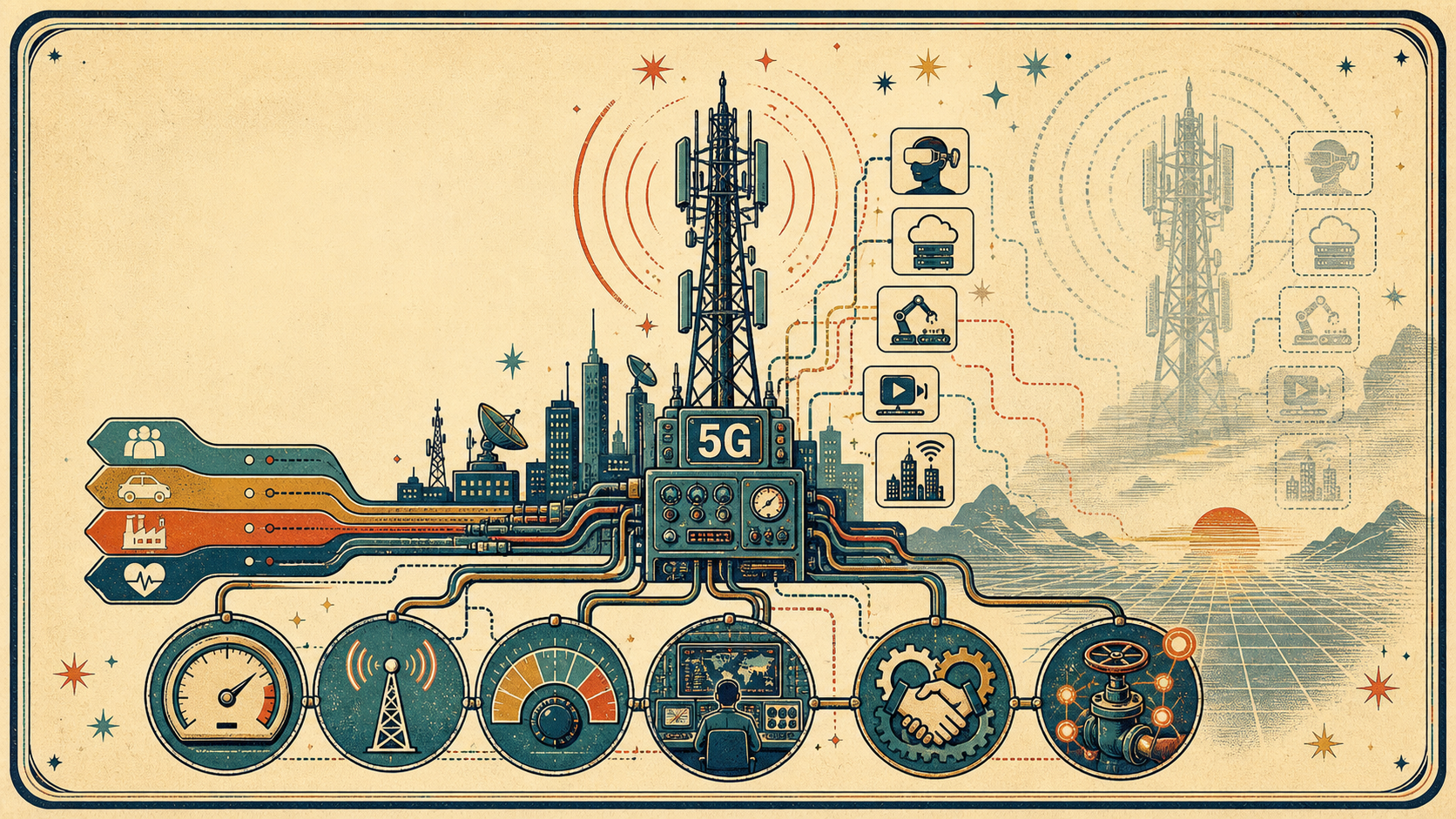

The introduction of 5G technologies in the telecommunications landscape represents a technological leap in the way data is switched. With it comes a big leap in terms of possible speeds and reduced latency. Equally as important, it offers unrivalled efficiency in spectrum management, and its ability to slice offers an opportunity for mini and micro operators to proliferate at little or no marginal cost.
The question arises as to whether these advances offer any new and meaningful business opportunities. At TAUSPACE we think they do. However, our survey shows that 5G networks globally have been mainly used for increased network speeds, and more commonly, as a parity tool. There seem to be little effort coming through to take advantage of the salient features of 5G networks and offer a plethora of new profitable and innovative services.11.For example, see *Light Reading*, "FWA Is Success Now, Hunt Is On for Next Big 5G Use Case," September 2022.
*It may well be the case of being too early to the market, but the go-to market is also complicated by the arduous processes involved in partnering between the application service providers and the telecom operators.
It should be noted that one particular business line, Fixed Wireless Access, has thoroughly proven itself globally since the introduction of commercial 5G services. For that reason, this line has been excluded from the white paper.
This white paper reviews the technically distinguishing features of 5G technologies, and looks at the business opportunities that are available to both operators and applications service providers. We also give our views on how the partnerships between operators and application service providers can be enhanced for the mutual benefit of the parties.
The white paper concludes that the key to unlocking the potential of 5G is enhanced partnerships between telecom operators and application service providers. Moreover, the revenue potential of innovative products and services taking advantage of the 5G technological innovations while still largely untapped is huge.
What are the Distinguishing Features of 5G Technology
Super Fast Speeds
This is, of course, the best-known feature of 5G. The technology offers super-fast speeds. 3GPP standards for 5G call for the following performance metrics:22.Qualcomm, *Leading the technology inventions for a unified more capable air interface*, December 2016.
- Peak data rates of 100Gbps
- Cell Edge data rate of 1000Mbps
- Latency of less than 1ms
- Cell Spectral Efficiency of more than 100 bps/Hz
- Integrity of service when the user is travelling at 1000 Km/hr
- Simultaneous Connections of up to 10,000 per km2
The actual performance is dependent on the quality of the network, but of the operators we have surveyed, most of these metrics have been reached. These specifications have, in turn, created a host of other challenges, mainly with the user equipment and backhaul infrastructure having to match the air-interface speeds as per the specifications.
The increased speeds will also require a plethora of new devices ranging from the simple wifi air speeds that can not go beyond 1 GBS in most common devices in the market today to the gigabit switches that would quickly be overwhelmed.
*Just like 5G is a complete break from the previous evolution of the technology that enabled it to make the giant leap forward, the new lines of business would need to be clean, drawn from a position of more is possible without encumbrances from legacy business models.
Thus, high speeds are a reality. However, new use cases need to be developed, bearing in mind that new sets of devices will be required.
End to End IP Signalling
The network elements talk to each other in machine-to-machine language, as has been the case in the older networks. However, what is different in 5G networks is that the signalling communication has been abstracted into an IP language. This is important because support systems around 5G networks are written in open language, making it easier and cheaper to develop new and hyper-flexible products.
Super Efficient use of Spectrum
The spectrum usage in 5G operations has been revolutionised by various features that make it possible to deliver a high MB/Hz rate:
- Massive MIMO
- Advanced Channel Coding
- Flexible slot-based framework
*The other technical aspect of the 3GPP that comes out is the heavy data delivery density and spectral efficiency aided by such innovations like massive MIMO. Spectrum is one of the more scarce resources and is getting more expensive by the day as regulators world over push more aggressive spectrum auctions.
What all these additions do is improve the amount of throughput that a 5G network can achieve for the spectrum that is allocated. The 3GPP specifications, if realised, reduce the per GB price of spectrum and the ability to push more in area means that a business case can be improved without having to necessarily increase the price.
Ability to Effortlessly Slice the Network
Network Slicing simply refers to running several virtualized instances of the network on the core using the same infrastructure. It is theoretically possible to slice 4G networks, but the capability is standardised in 5G networks by the core specifications from 3GPP. In these standards, the core network is supposed to be deployed in virtualized instances.33.3GPP TS 23.501 — System Architecture for the 5G System, defining network slicing as a fundamental capability of the 5G core.
What slicing means in practical terms is that two or more operators can share the network and seem to be completely different to the end user, hence affording opportunity for differentiation. One of our clients is an MVNO in Africa who has managed to get an IMSI range and a mobile network code from the regulator. Thus, from a consumer perspective, it seems as if the MVNO is a fully-fledged network operator with all the attendant effects on brand equity.
So, What are the New Opportunities
Bundled Products with Cable Service Providers
In September 2022, the immensely popular American football programming, Thursday Night Football, moved from its traditional home at Fox Sports to Amazon Prime. All that one needs to stream the football is an Amazon Prime account and a big enough pipe, and voila! You can watch Thursday night football. One immediate effect was broadcast quality that improved several folds.44.Amazon's Thursday Night Football broadcast in 8K demonstrated the bandwidth potential of next-generation content delivery over high-speed networks.
*The Camera work was conducted using 8K output, but the Cable quality over which it was delivered was 4K at best. Americans who had 8K capable TVs and a good enough internet connection, were introduced to a new work of hyper-definition content.
Bundling of Premium broadcast content and selling it on a pay-per-view basis will form a basis of a win-win partnership between 5G operators and broadcasters to deliver the next $20 Increase in ARPU at a relatively low cost. The operators already have the infrastructure to deliver content as well as the means to commercially increase a subscriber's throughput during the consumption of a particular content.
Enhanced broadcast experience is one of the many opportunities that leverage ultra-high speeds offered by 5G coupled with innovative partnerships. But the model is the same:
- Identify niche area that requires high-speed, low latency high-performance density
- Identify content providers/applications service providers
- Forge a win-win partnership
- Create and market the products identified
Of course, content streaming does not necessarily stop with broadcasters. Nothing stops 5G operators from partnering with more non-traditional content providers, like those found on Youtube, who would like to charge a fee for viewing their content.
INTERESTED IN 5G STRATEGY?
Let TAUSPACE guide your 5G transformation
Our next-generation BSS platform is built for the partnerships and service models that 5G demands. Talk to our team about unlocking new revenue streams.
Talk to an ExpertInternet of Things Comes of Age
It is the most interesting paradox that the internet of things has not moved into mainstream use despite the concepts and technology having matured more than 10 years ago. Theoretically, IoT has a very limited payload that should not stress even the second-generation networks. But potential IoT applications have low per-element ARPU. Moreover, the sheer number of elements required to simply provide a coherent application gives them the potential to overwhelm commercial networks with potentially low returns.
5G solves this problem by having a huge user density ability as well as simplifying the architecture of the IoT elements required. Moreover, with the increased use of eSIMs and IoT SIMs, we should start seeing ultra low-cost elements that will make IoT a reality. Whether it is a water leakage monitoring system or online power metering, IoT is getting there, thanks to 5G networks.55.The proliferation of eSIM and IoT-specific SIM technology is expected to drive IoT element costs below $1 per unit by 2026.
The real business opportunity lies with application service providers and IoT integrators partnering with the 5G operators to bring the opportunities to bear.
Virtual Augmented Reality has the Potential. But there is a Caveat
VAR is one of the applications that seem to be tailor-made for 5G. It is a huge bandwind hog that requires low latency in order to work optimally and gel the various elements. In most instances, the end-user experience will to a large extent, be dependent upon the data carrier.
5G technology simply ticks all the boxes on the use of VAR technologies. But to date, large-scale killer apps have not been introduced to the market. We think we are just around the corner, and the evidence comes from a different piece of real estate, the metaverse.
*The scramble for virtual real estate that has been set off by especially credible players in the market suggests that the mental barrier has been breached. The next step is to get the killer app.
We think that the killer app will be some immersive experience in travel and value-added services on top. Thus, just like the metaverse, it will not be a one-to-one translation. The Virtual part of VAR will be given equal balance. And this is the important caveat. We think the applications are around the corner, but we do not think the ones existing in the market will be the form that the killer app will take.
Smart Cities have the Opportunity to move from Buzzword to Reality
A smart city is a technologically modern urban area that uses different types of electronic methods and sensors to collect specific data. The use of enhanced IoT infrastructure will be the basis on which Smart Cities become a reality. The low-hanging fruits are:
- Water and Wastewater networks monitoring
- Water, Power, and Gas Smart metering
- Power consumption optimization
- Traffic Monitoring
- Air Quality Optimization (in collaboration with vehicular traffic monitoring)
- Public transport monitoring
- Smart Street lighting
The potential for the Smart Cities applications is endless. How to monetise it is a completely different cup of tea. The business case for paying for smart city conveniences is shaky beyond governments and regional authorities. The ability to perceive benefits for retail consumers, hence pay, is limited at best.66.McKinsey Global Institute, *Smart Cities: Digital Solutions for a More Livable Future*, estimates that only 8% of smart city applications have a clear consumer-pay business model.
Thus marketing these opportunities at scale will remain either with governments or private smart city developers. The difficulty that telecommunications operators face is that they are not experienced in selling to governments and governmental authorities. Thus the partnerships needed to bring these opportunities to bear would be between operators, application service providers, and integrators.
Mini, Micro, and Community Telecommunications Network (MMC) have the Opportunity to move the Access Needle
The 5G networks rolled out promise to have a low GB per Hz charge, high Gb per square kilometre, and simplified control plane on the core network. Added to this is the ability to slice the network core to give a virtual operator unprecedented control over their subnet.
The highest upfront cost item for a mini, community, and micro operator would be the network slicing charge, which in our opinion, does not affect the business case for these small operators substantially. We think that such networks should be able to profitably service small operators with a platform that has a floor of, say, 5,000 subscribers. On the other hand, the operator needs several of these operations in order to make commercial sense.
Traditional Telecommunications Operators have an Opportunity to Increase their Revenue in non-Traditional Ways
The lower costs of data throughput for 5G networks introduce new opportunities for improving existing services and creating new business opportunities. Traditionally, one of the biggest headaches for operators has been the high demand on the spectrum for voice leading to lower call quality and obviously overloaded networks.
The way operators have gone about solving this problem is moving their voice traffic to VoLTE. VOLTE is simply a data call that is managed by the handset. With a complete shift to VoLTE traffic, operators are finding huge gains in their spectrum usage. With 5G offering even higher throughput, the operators are set to deliver their voice calls over a cheaper network.
*Already, AT&T in the USA has shut down their 3G network in order to route their voice calls over data. Similarly, T-Mobile has followed suit, although they have retained their 2G network in a limited way. This is a welcome break for operators because whereas voice revenues have been steadily reducing, the cost of delivering voice has not.
There emerges a spectre of legacy operators offloading their voice traffic to 5G operators. This will simply be done by slicing the network for legacy operators who will appear not to be even roaming! This indeed will be the apex of Network as a Service (NaaS) offering.
On the business side, 5G has defined very efficient interfaces with the Business Support Systems. This means that the more modern BSS systems will have the ability to support highly flexible business strategies. This, in turn, will be able to make the operators take advantage of what 5G has to offer.
How about Rural Telecommunications? Is there a Business Opportunity?
5G offers a very different form of opportunity for rural areas that have been traditionally starved of broadband access. It is easier to roll out over a large area than fibre optic cables. However, the traditional concerns of telecommunications operators remain. Will it make commercial sense?
Globally, the definition of rural areas differs from sparsely populated Australian Outbacks to very densely populated parts of the Deccan Plateau in India. Thus, our sense is that it will make sense in some cases and not so much so in others, in which case governments and other social actors will have to take up the slack.
Our view is that rural communication will thus be dependent on specific use cases but, in all cases, will be boosted by the advent of 5G technology.
In Conclusion, how can Telcos Forge Meaningful Partnerships with Application Service Providers and Other Third Parties?
To ask the question in a different way, what will the telco of the future that has successfully managed not to be disintermediated look like? We think the telco will look more like an eCommerce platform and less like a traditional telco.
It will have developed an ecosystem of third parties such as application service providers, content providers, Mini, Micro, and Community (MMC) Telcos, System Integrators, Public Sector Management Specialists, etc.
The telco at the very bottom will provide NaaS services and access. In between, the next generation BSS will integrate the third parties and manage SLAs and revenue split.
This Business Architecture ensures that the 5G operator is not disintermediated but, on the other hand, offers the various third parties the ability to scale in a way that telecom operators are used to.
How will the 5G operators manage the partnership that realises this ecosystem? Traditionally, telecom operators have been averse to dealing with partners as equals, considering that the return on investment may not be immediately obvious. And that reality will not change.
One way of ensuring that is simply adopting an approach where the default position is that any third party, after basic due diligence, is allowed into the platform. With time, the revenue-sharing engine can be tuned to incorporate some AI-powered revenue sharing management. This would work with smaller third parties. For bigger third parties, such as broadcast partners and municipalities, the partnership can be handled traditionally using accounts managers and human interaction.
For the 5G operators, creating partnerships will be a difficult and unusual task, but those who get it right will be handsomely rewarded. They will become the Next Generation Performing Networks.