


Home
TAUSPACE
TAUSPACE
  • Home
Talk to us

Telecoms · Sustainability

Embracing the Green Cities Revolution and the Role of Telecoms

The transition from smart cities to green cities requires collective effort, with telecommunications companies serving as catalysts for environmental transformation.

Written By
Industry Analyst Team
Publish Date
February 5, 20243 min read
Share

Embracing the Green Cities Revolution and the Role of Telecoms

The Limits of Smart Cities

Smart cities leverage technology to improve efficiency, optimize infrastructure, and enhance residents' quality of life through initiatives such as:

  • Smart grids utilizing real-time data to optimize energy consumption and integrate renewable resources
  • Smart transportation implementing traffic management systems and promoting electric vehicles to reduce emissions
  • Smart buildings employing automation and sensor technology to improve energy and water efficiency

However, smart cities often struggle with limited focus on sustainability, exacerbated inequalities, and technology dependence that raises concerns about cyberattack vulnerability and maintenance costs.

Green Cities: Embracing a Sustainable Future

Green cities prioritize environmental responsibility and ecological balance alongside technological advancements by:

  • Promoting renewable energy sources (solar, wind, geothermal)
  • Enhancing energy efficiency across buildings, appliances, and transportation
  • Building green infrastructure including parks, gardens, and green roofs
  • Adopting circular economy principles to minimize waste
  • Prioritizing sustainable transportation options

Telecommunications: A Key Player in the Green City Transition

Telecom companies can develop smart grids, support transportation systems, connect environmental monitoring infrastructure, empower citizens with sustainability tools, and facilitate cross-sector collaboration.
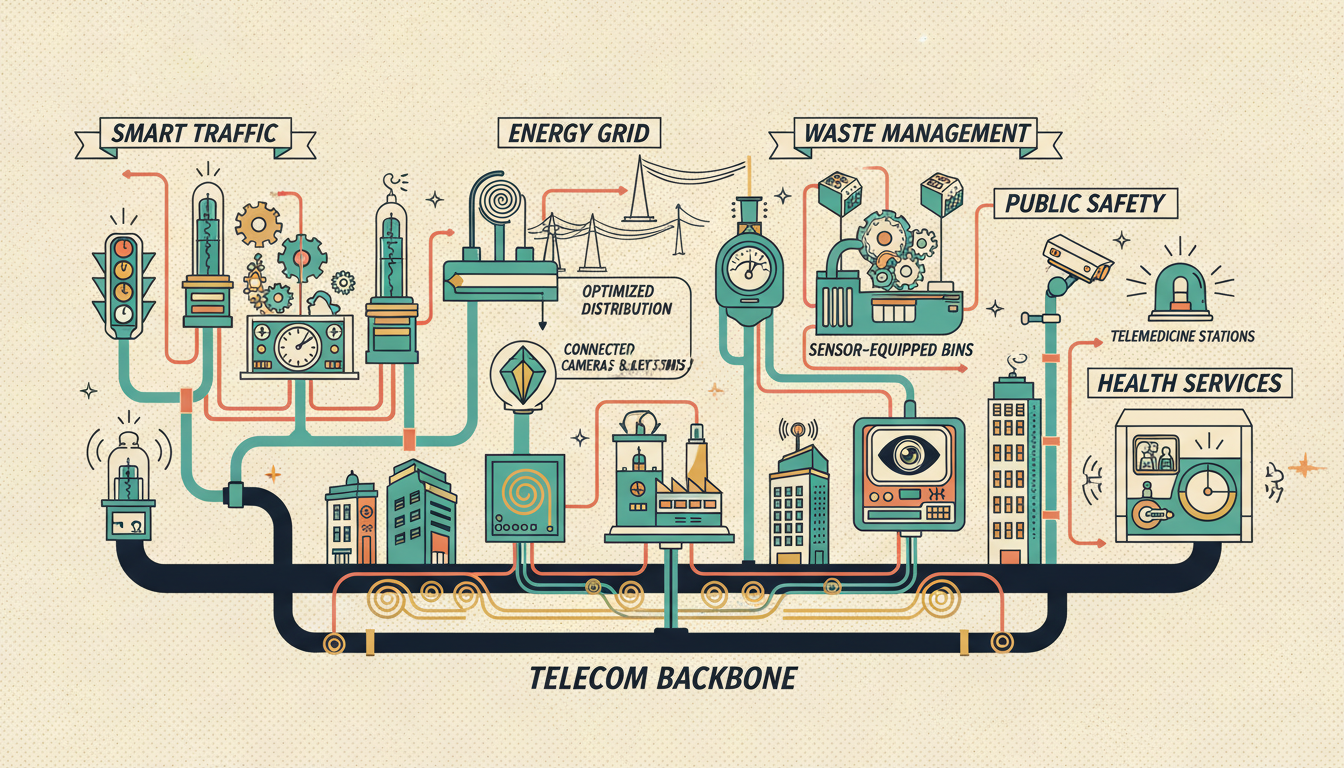
A retro cutaway cross-section of a city block showing interconnected smart systems on a telecom backbone: Smart Traffic, Energy Grid, Waste Management, Public Safety, and Health Services

Beyond infrastructure, telecoms can advocate for sustainability policies, support green businesses, educate communities, and promote transparency on environmental impact.

Case Studies: Leading the Way to Green Cities

Barcelona, Spain: Features 20,000+ active sensors and CityOS platform targeting emissions-free public transportation by 2025.
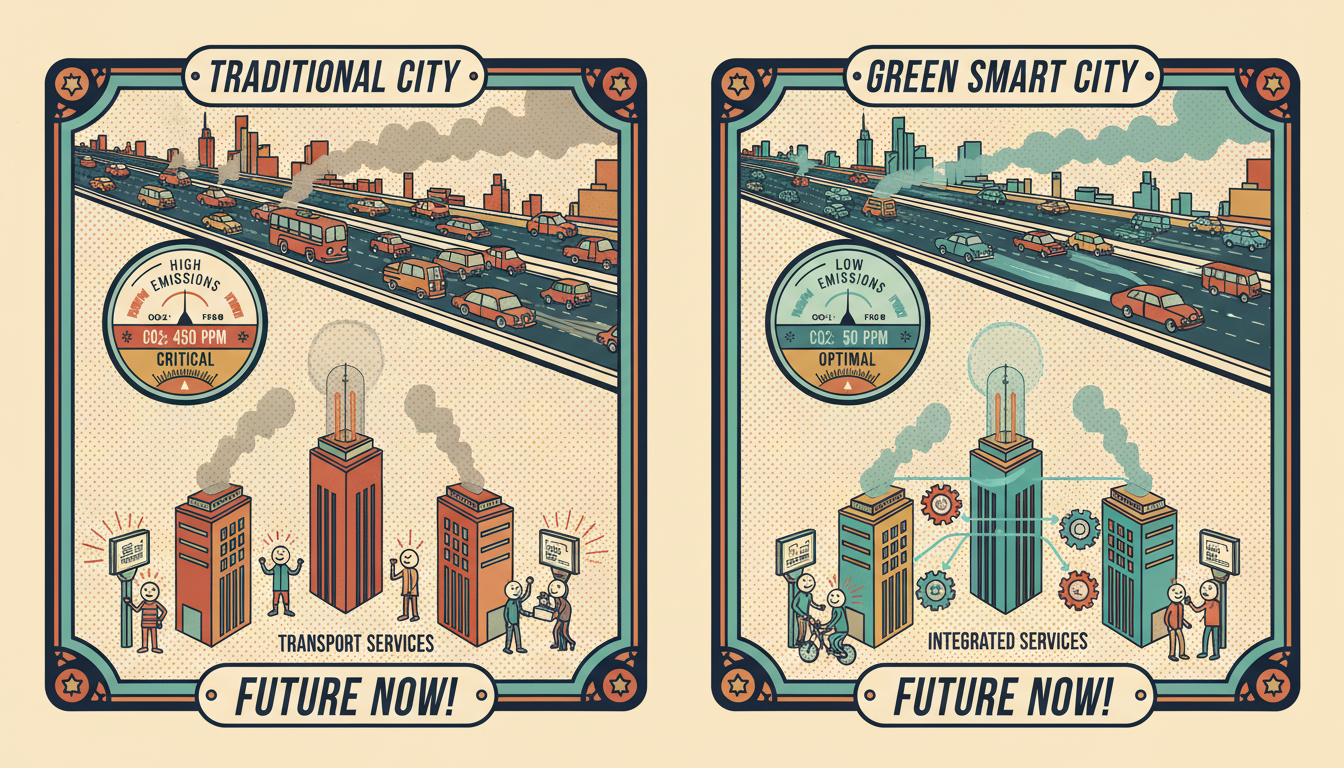
A retro before-and-after comparison of a Traditional City (congested, high emissions, disconnected) versus a Green Smart City (optimized traffic, low emissions, integrated services)

Singapore: S$50 million investment backing the Smart Nation initiative, with Green Building Masterplan targeting 80% of buildings going green by 2030.

Seoul, South Korea: Uses environmental sensors for senior citizen safety; plans solar panel coverage on all buildings by 2030.

Copenhagen, Denmark: Aims to become the world's first carbon-neutral capital through smart street lights, sustainable transportation, and IoT technology integration.

Conclusion

The transition from smart cities to green cities requires collective effort. Telecommunications companies can serve as catalysts for environmental transformation by combining technological innovation with ecological responsibility.


Related Articles

5G and a Greener Future: Opportunities and Challenges
Telecoms5G

5G and a Greener Future: Opportunities and Challenges

The rollout of 5G promises unprecedented connectivity but raises critical questions about environmental sustainability and energy consumption.

3 min readRead More
5G and Renewable Energy: Powering a Greener Future
Telecoms5G

5G and Renewable Energy: Powering a Greener Future

5G and renewable energy technologies are converging to revolutionize electricity generation, distribution, and consumption through IoT-enabled smart grids and real-time monitoring.

3 min readRead More
Accelerating Transformation with AI and Green Innovation in Africa
TelecomsCybersecurity

Accelerating Transformation with AI and Green Innovation in Africa

As Africa Industrialisation Week unfolds in Kampala, the focus is on leveraging AI and green practices to drive structural transformation—unlocking sustainable growth, job creation, and stronger environmental stewardship.

3 min readRead More

Ready to discuss your transformation?

Our team has helped operators, banks, and digital brands across four continents navigate complex BSS/OSS challenges. Let's explore how we can help you.

Talk to an ExpertExplore fullCIRCLE NEXT
TAUSPACE

Carrier-grade platforms and advisory for the telecom businesses being built right now.

Phone+27 10 140 6574
Email[email protected]
South African Office1 Montecasino Blvd, The Pivot Block C,
Fourways, South Africa
North American Office16192 Coastal HWY, Lewes, DE 19958,
USA

Platforms

  • fullCIRCLE NEXT
  • Advance.ME
  • 5G charging and policy
  • Digital BSS and commerce
  • Customer value management
  • Modules

Advisory

  • Advisory overview
  • Strategy and business case
  • BSS/OSS migration
  • Bank MVNO advisory
  • Programme assurance

Explore

  • Use cases
  • Experience
  • Clients
  • Insights
  • Contact

TAUSPACE

  • Why TAUSPACE
  • Our story
  • Expertise
  • Partners
  • Careers
PrivacySecurity & data protectionGDPRTerms & conditions
© TAUSPACE. All rights reserved.