


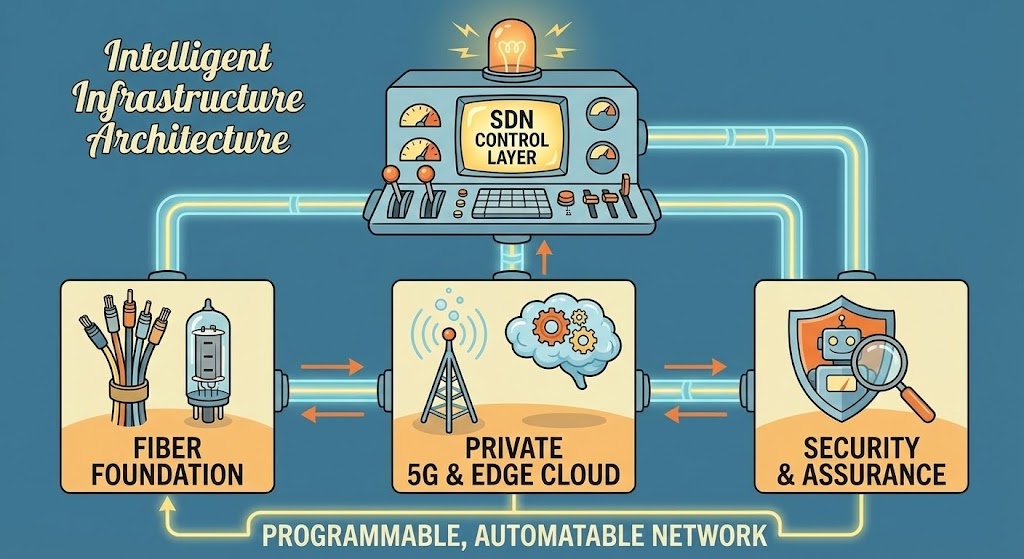
Fiber optics is still the backbone of high-performance connectivity—and that isn’t changing. What is changing is where network differentiation is created: increasingly, it’s not just in raw capacity, but in how quickly networks can be configured, assured, and secured across fiber, IP, and wireless domains.
In practical terms, we are entering an intelligent infrastructure cycle defined by three forces:
- Complexity is rising (multi-vendor stacks, disaggregated networks, cloud-native platforms, new service types).
- Expectations are rising (enterprise SLAs, near real-time provisioning, tighter security postures).
- Budgets are tight (pressure to reduce manual operations, truck rolls, and mean-time-to-repair).
TAUSPACE’s position in this ecosystem is grounded in what operators and digital brands need now: strengthening fiber operations, enabling SDN-driven programmability, integrating private 5G, and advancing practical experimentation through labs focused on real-time network orchestration.
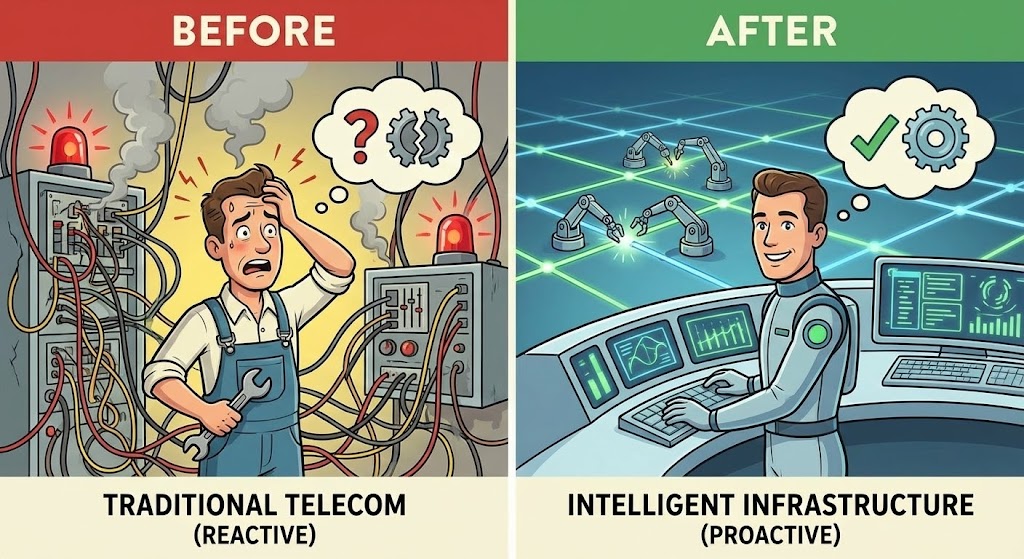
Why “Traditional Telecom” Operating Models Are Under Strain
Many networks still rely on workflows that were designed for slower service cycles and more predictable environments. That model is increasingly stretched by:
- Faster service lifecycles: enterprise and digital services are launched, changed, and retired more frequently.
- Cross-domain dependencies: the customer experience depends on transport, routing, security, and (often) mobile/edge components working together.
- Operational data gaps: inventory, telemetry, and assurance data are often fragmented across tools and teams.
- Security and resilience requirements: threats, regulation, and supply chain risk raise the bar on visibility and control.
This is the context for “intelligent infrastructure”: not a marketing rebrand of fiber, but a shift toward programmable, observable, and automatable networks that can scale operationally.
10 Shifts Defining the Intelligent Infrastructure Era
1) Fiber becomes a programmable foundation, not a static asset
The strategic move is from “build and hope” to build and control—using software-driven approaches to plan, configure, and manage transport more dynamically. This is where SDN and standardised interfaces matter: they reduce friction between planning, provisioning, and assurance.
Focus on: enabling SDN-aligned operating patterns that make fiber infrastructure easier to orchestrate and change safely.
2) The center of gravity moves from build-out to operations excellence
For many operators, the largest value creation opportunity is no longer incremental capacity alone—it’s improving service turn-up time, fault isolation, and operational efficiency.
Focus on: supporting fiber operations with an emphasis on repeatability, automation readiness, and operational performance.
3) Real-time visibility becomes a prerequisite for automation
“Intelligent” networks aren’t intelligent because they use AI buzzwords—they’re intelligent because they have reliable telemetry, consistent models, and actionable observability. Without that, automation becomes brittle and risky.
Practical implication: invest early in data foundations (inventory alignment, event correlation, performance signals) before attempting full closed-loop automation.
4) Assurance shifts from reactive troubleshooting to continuous control
Assurance is moving from post-incident analysis to continuous monitoring and proactive risk reduction. The business outcome is fewer service-impacting incidents and faster recovery when something does go wrong.
Focus on: labs focused on real-time network orchestration—where “observe → decide → act” workflows are tested in realistic operating conditions.
5) SDN becomes a control strategy, not a single product choice
SDN is most useful when treated as an operational control layer that coordinates intent and policy across domains—rather than as a one-off implementation in a single part of the network.
Outcome: more consistent provisioning, fewer manual steps, and less configuration drift.
6) Private 5G drives new service combinations
Private 5G expands what enterprises expect: predictable performance, segmented traffic, integrated security, and connectivity that reaches places Wi‑Fi and fixed alone may not. Importantly, private 5G is rarely “standalone”—it depends on strong backhaul, edge compute options, and service assurance.
Focus on: supporting private 5G integration alongside fiber and SDN-driven operational patterns.
7) Edge computing raises the bar on latency, placement, and governance
Edge isn’t just “compute closer to users.” It adds operational complexity: workload placement, backhaul constraints, and governance across distributed sites. Transport and orchestration need to work together to make edge viable at scale.
Practical implication: prioritize operational repeatability—templates, policy, and lifecycle management—over bespoke deployments.
8) Security becomes architectural: segmentation, least privilege, and resilience
Network security is increasingly built into how services are designed and operated—through segmentation, policy control, and continuous validation—rather than bolted on at the end. This matters even more as networks become more programmable.
Practical implication: treat automation and security as linked disciplines (change control, auditability, policy enforcement, and rollback).
9) Sustainability becomes an operations metric, not just a materials story
Fiber is often more energy-efficient than legacy alternatives, but sustainability gains are most visible in operational reduction: fewer truck rolls, better capacity planning, faster fault resolution, and smarter lifecycle management.
Practical implication: measure energy and emissions impact through operational KPIs as well as infrastructure choices.
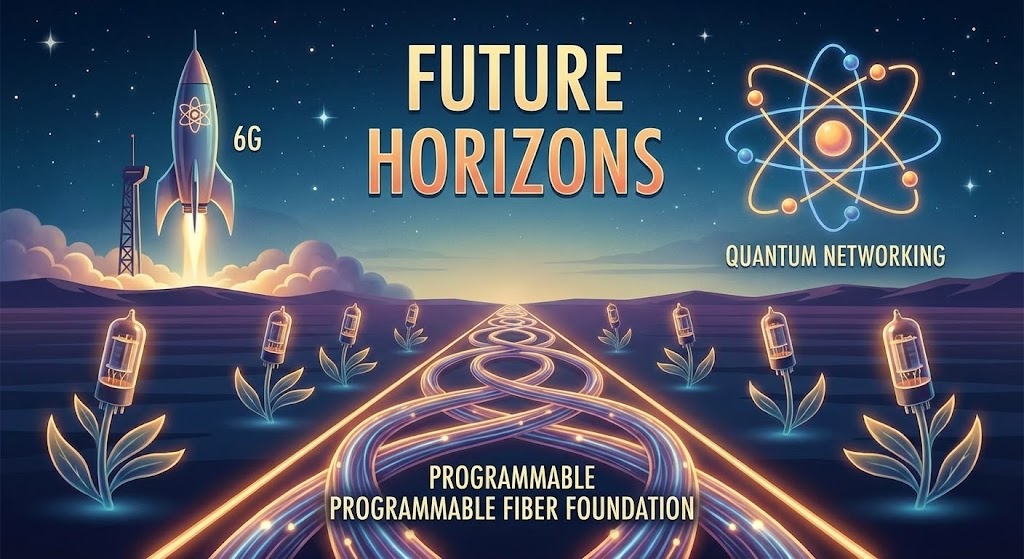
10) “Future horizons” matter—but should be handled as roadmap discipline
Topics like 6G and quantum networking are important signals—but they should be addressed with a clear horizon framework:
- Near term: build programmability, observability, and operational control.
- Mid term: expand closed-loop workflows and cross-domain orchestration.
- Longer term: monitor standards and ecosystem maturity; design for crypto agility and architectural flexibility.
Focus on: grounding today’s deployments in operational reality, while using labs to explore real-time orchestration approaches that can carry forward as the ecosystem evolves.
Key Takeaways
- Fiber remains the foundation—but the next wave of differentiation is programmability and operational control.
- “Intelligent infrastructure” is best treated as a data + automation + assurance journey, not a single upgrade project.
- SDN and real-time orchestration are valuable when they reduce operational friction and increase service reliability.
- Private 5G is accelerating demand for integrated, cross-domain service delivery (transport + wireless + edge + security).
- TAUSPACE’s role is to help teams modernise incrementally—supporting fiber operations today while advancing real-time network orchestration capability for what comes next.
Follow us for updates on LinkedIn
READY TO MODERNISE NETWORK OPERATIONS?
Build programmable networks—pragmatically, layer by layer
TAUSPACE supports operators and digital brands with today’s priorities—fiber operations, SDN-enabled control, and private 5G integration—while advancing real-time network orchestration in our labs. Start with a strong data foundation, automate the repeatable work, and scale toward closed-loop operations as your network and services evolve.
Talk to Us